Monday, August 9, 2010

Solar Wind

The Boston Globe Ideas section had a nice explanation of the Northern Lights. 

However, it is not quite right to say "...[charged particles] are carried outward by the solar wind." 

My understanding is that the charged particles ARE the solar wind!  Also, Newton's first law will get the charged particles to Earth just fine after they have been thrown off of the surface of the Sun.  (no need to be "carried" - inertia does the trick).

Might seem picky, but just like you are not pushed forward to tomorrow by time nor is water pushed towards shore by waves;  i's just not quite right.

The articled also misses a nice symmetry in regards to the northern lights:  Magnetism.  Although the Earth's magnetic field is mentioned as a deflector of most charged particles, the article seems to imply that some particles just happen  to "come hurtling toward the atmosphere at the north and south magnetic poles".  In actuality, the charged particles are spiraling around the magnetic field lines and those fields themselves bring them to the north and south pole (which is where the magnetic field lines exit and enter the Earth). 
The symmetry bit is that magnetic field lines are the original cause of the Solar Eruptions that flung the particles into space in the first place:

The Sun's magnetic field lines throws 'em out and the Eath's magnetic field catches 'em.  That is the outerspace baseball game we catch the tail end of and call "Northern Lights".

Monday, April 26, 2010

Snowflakes

Scientific American just turned me onto this one:  No more four or five sided snowflakes, please!  The real six sided  (always six sided!) ones are beautiful enough:

(picture from snowcrystals.com)
No big deal, though - right?  Humans have five fingers but sometimes they have only four in cartoons.  True enough, but I think we all know the difference - and besides we are all a little creeped out when we notice the missing digit.  No one seems to get creeped out by a five sided snowflake

The six sides of a snowflake come from the hexagonal shape of the solid form of water.  If it didn't have that shape, then ice wouldn't float and we probably could not have evolved on this planet.   Primitive ocean life needs the ice to float so it can survive in the waters underneath.

Moon and Stars

When the moon is not full, is it still there?  Of course it is, but many paintings and drawings will show a crescent moon with a star (or stars) right in the middle of the dark side of the moon.  Children's books are some of the worst offenders.  For example, see the picture below  (taken from "Sleepy Dog" a Step Into Reading book by Harriet Ziefert (illustrated by Norman Gorbaty)).

Showing the moon and stars in this configuration is like saying "When Julius Ceaser ruled Rome in 500 BC".  I won't comment on the "turn on the moon" part 'cause that's kind of cute, right?  I mean "notice the reflection of the sun's light now made more dramatic by the surrounding darkness" just doesn't have that easy reader feel...

Saturday, April 24, 2010

Solar Eclipses and Robin Hood

In a recent episode of the BBC show Robin Hood ("Total Eclipse"), a daring rescue is executed at the moment of solar eclipse.  Standard fare, but within minutes of the eclipse we see a shot of Robin Hood with a moon in the back ground and the sun nowhere to be seen.  To top it all off, the moon is only 3/4 full! 


Showing a non full moon on a solar eclipse day is like showing a haiku-style poem and saying "Do you like the sonnet I have written?"

Saturday, April 3, 2010

Warming Up in Springtime

The local news just reported that we are "finally warming up as the sun gets closer, err, the angle gets closer".  It is a deeply entrenched belief that things only feel warmer when they are closer.  Most people know that the Earth is not actually closer to the Sun in the summer, but I think the angle of the sun's rays argument confuses the issue because it's not intuitive for them. 

Why can't we just say that because of the axial tilt, in the spring the days get longer (while the nights get shorter) and we get more hours of sunlight and that's why we warm up?  Of course both are happening and contributing, but I think the hours of exposure is more intuitive.

It's not that we are stepping closer to the campfire to warm up, it's that as we spin in place, we are spending more time facing the fire than facing away from the fire...
Hours of daylight vs. Angle Effect graphs can be found here.

It's complicated, but I think this NASA site sums it up nicely:
"Although the length of the day is an important factor in explaining why summers are hot and winter cold, the angle of sunlight is probably more important." (emphasis mine)

When we emphasize the abstract angle argument to kids and they don't get it, they go right back to thinking we are farther away.  Start with the partial truth to replace the untruth and then work our way up methinks...

Eating Beef vs. Driving your Car

Latest headlines: "Eating beef causes more environmental damage than driving your car"

You gotta love oversimplification.  There are so many variables involved.  Is the study counting the production and maintenance costs of the car itself?  Is the cow corn-fed or grass grazing?  I was looking for a scientific source on the old "is it more environmentally friendly to stop driving your car or to stop eating beef" question and the only thing I came across was this from Scientific American:
"Producing the annual beef diet of the average American emits as much greenhouse gas as a car driven more than 1,800 miles"

The average car in america is driven over 12,000 miles per year so an average american driving averagely eating an average amount of beef is still harming the environment by a factor of 6-7 times more simply by driving compared to their beef eating.  The larger truth is the Buddhist maxim - there is nothing you do in life that is pure good.  You have to look at your own lifestyle and make reasonable changes to decrease your own personal footprint.

How about "Having children is the most ecologically damaging thing you will every do in your life" as a headline?  Just being alive has an environmental cost, give us some headlines that help us make reasonable incremental changes, please!

Sunday, February 14, 2010

Fibonacci Who?

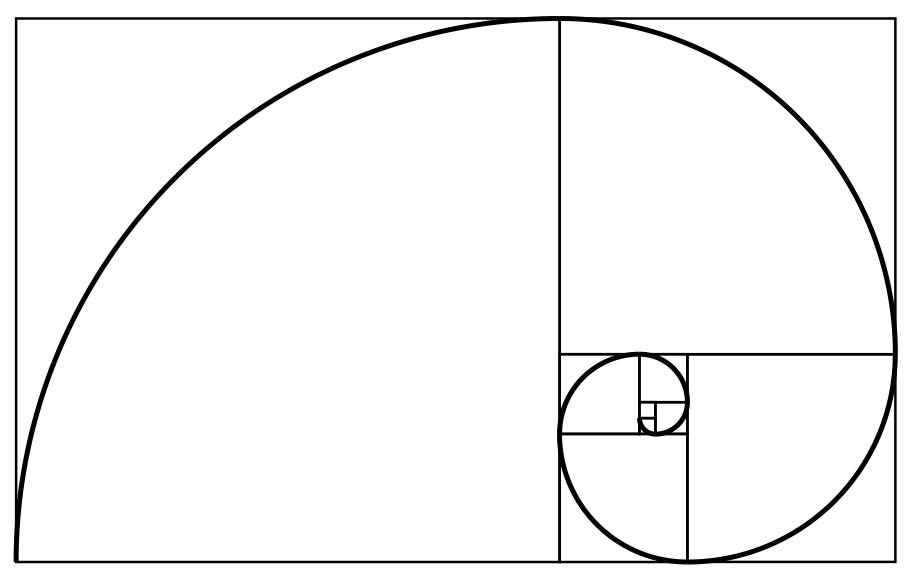
In today's Boston Globe, in an otherwise insightful book review, the reviewer felt obliged to place the famous Fibonacci Series (1,1,2,3,5,8,13,...) in the reader's mind by reminding them the series was "made famous by 'The Di Vinci Code' "!?
 
Indeed, just like when you reference Shakespeare, you'd best remind me that he was the main character in that movie "Shakespeare in Love" or else I might not know who you were talking about!