In today's Boston Globe, in an otherwise insightful book review, the reviewer felt obliged to place the famous Fibonacci Series (1,1,2,3,5,8,13,...) in the reader's mind by reminding them the series was "made famous by 'The Di Vinci Code' "!?
Indeed, just like when you reference Shakespeare, you'd best remind me that he was the main character in that movie "Shakespeare in Love" or else I might not know who you were talking about!
In general., I love PBSkids. They seem to be making a big push on science. Zula Patrol is one of the shows that is all about science and I have been very impressed with it, usually. But today, in "Hey Kids, Amazing Space Monkeys!", they disappointed me.
Centripetal Motion is a tricky subject and I find I have to do a lot of careful unpacking of what students think they already know happens when you travel in a circle. In this episode, the Zula Patrol explains that a "centrifical [sic] force pushes stuff out" when you travel in a circle. No no no! Centrifugal forces push things out and they don't exist when you are going in a circle - a centripetal (center seeking) force pulls you in while your inertia wants to carry you out - along a tangent straight line!
Getting this wrong just hammers in the everyday incorrect perception of what is happening. Later in the same episode, they go down to the molecular level trying to explain with nice visuals what is happening when a solute is dissolving in a solute. How hard would it have been to show an overhead shot of things spinning out of the circle along a tangent line and making the lesson about inertia rather than force?
It's like saying someone was "deported" from the country when they really were just leaving on a business trip.
"Today it the temperature will be 10 degrees but the wind chill will make it feel like -5"
Wind Chill is NOT how it will "feel" - it is a model of how fast your skin may cool down towards the actual temperature. It is a model that makes a whole LOT of assumptions (most of which are probably untrue as you go out into a cold, windy day). Slate.com has a good article about this here.
This is like saying you may overshoot your destination today because the traffic is bad. Stick the facts please: just tell us the temperature and the wind speed.
Watching our local channel this morning (WBZ) and the weather map of local temperatures had a big "-0" in the middle of other chilly temperatures throughout the area.
Negative Zero? That's like trying to make a noun into the past tense! Makes no sense.
I tried to find the exact map on their website, but I couldn't find it - this is the type of map I'm talking about:
...he will demonstrate great spelling abilities but write down mathematical nonsense:
(image captured from google books where it was displayed curtesy of HarperCollinsPublishing)
We've been reading this book at home for years - If You Take a Mouse to School by Laura Numeroff and Felicia Bond. Great little story for kids - but check out this page. The spelling is all legit, but difficult words. But the math - oh my! It's mostly gibberish. Why? Why not use high-level calculus, which would probably look equally confusing to the average person but would actually be legit?
And lest you think this is an isolated occurrence - check out this puzzle featuring a Wubbzy, a Nick Jr. character:
Apparently, a strong grasp of mathematical nonsense is central to an academic environment.
Recently, NPR ran a story on the finding of possibly high levels of antimony in a certain toy. I did not hear the original piece, but I did hear NPR reading from a listener's letter complaining about NPR's confusing the subtle distinction between "a chemical" and "a chemical element."
So, in the midst of apologizing for calling antimony a 'chemical', the host says that he "sees antimony right there on the periodic table between tin and tellurium, with an atomic mass of 51)"
While retracting on something that probably wasn't wrong in the first place, they make a definite blunder and confuse atomic mass with atomic number. That's like confusing the number of men at a party with the number of people at a party! Atomic mass counts protons and neutrons and the average number for antimony is 122. 51 is the atomic number and merely the number of protons.
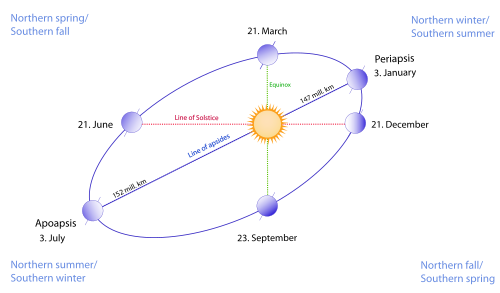
Someone forwarded me a nice Boston Globe Editorial about the winter solstice and how it's the real reason for the season and all that. Right off the bat, though, while correcting one misconception about the seasons, they insert the following: "...the earth, in its elliptical revolution, only adjusts the tilt in its rotation..." (emphasis mine)
True 'tis the axial tilt that causes the seasons, but there is no "adjusting." The Earth keeps its orientation while orbiting the Sun - so the North Pole is leaning inward sometimes and outwards at other times. Saying the tilt is adjusting is like saying I've gotten younger just because someone older than me has walked into the room!
Teaching high school physics and trying to teach astronomy.
Married with two kids.
Ex-microplumber.
Ex-wine importer.
Beer Brewer. Lived in 7 states. Spent time in 19 different countries. Have bald spot - getting old.